Exam results had just come out. The screen showed us the results, and for a moment, it seemed everything was resolved, and a lifetime of hard work, sleepless nights, and anticipation had boiled down to a single result. For some, it brought relief. For others, there was a hint of doubt.
But beneath the immediate reaction, a deeper question remained: Do marks really define what comes next?
For generations, academic performance has been treated as the primary measure of ability. High scores were seen as proof of intelligence, discipline, and potential. And while marks can reflect effort and understanding, they are only one part of a much larger picture.
The Illusion of Marks as a Predictor of Success
Marks are structured. They assess a person's ability to grasp a syllabus, memorize, and work under test conditions. But success in the real world doesn't work this way.
Success is not about correct answers. They are founded on uncertainty, on solving new problems, and on change. These tasks cannot be fully assessed through a test.
There is no question paper in the workplace. Problems are open-ended. Information is incomplete. Decisions carry consequences. It is clarity of action in these circumstances that is important.
Marks may open doors, but they do not determine how far someone can go in life.
The Power of Confidence in Real-World Performance
Confidence is often misunderstood as personality. In reality, it is built through experience. It comes from doing, failing, learning, and trying again.
A confident individual is not someone who knows everything. It is someone who trusts their ability to figure things out. This trust becomes critical in moments where there is no clear path forward.
In interviews, confidence shapes how ideas are communicated. In teams, it influences how individuals contribute and collaborate. In leadership, it determines how decisions are made under pressure.
Unlike marks, confidence cannot be memorized. It must be developed.
From Passive Learning to Active Capability
One of the biggest gaps in traditional education is the focus on passive learning. Students are trained to absorb information, follow instructions, and produce correct answers.
But the real world rewards active capability.
This means being able to apply knowledge, not just recall it. It means building, experimenting, and solving. It means learning how to think, not just what to think.
When students engage with real problems, something shifts. They begin to take ownership of outcomes. They learn how to deal with ambiguity. They understand that mistakes are not failures, but part of the process.
Over time, this builds both competence and confidence.
What Actually Determines Career Success
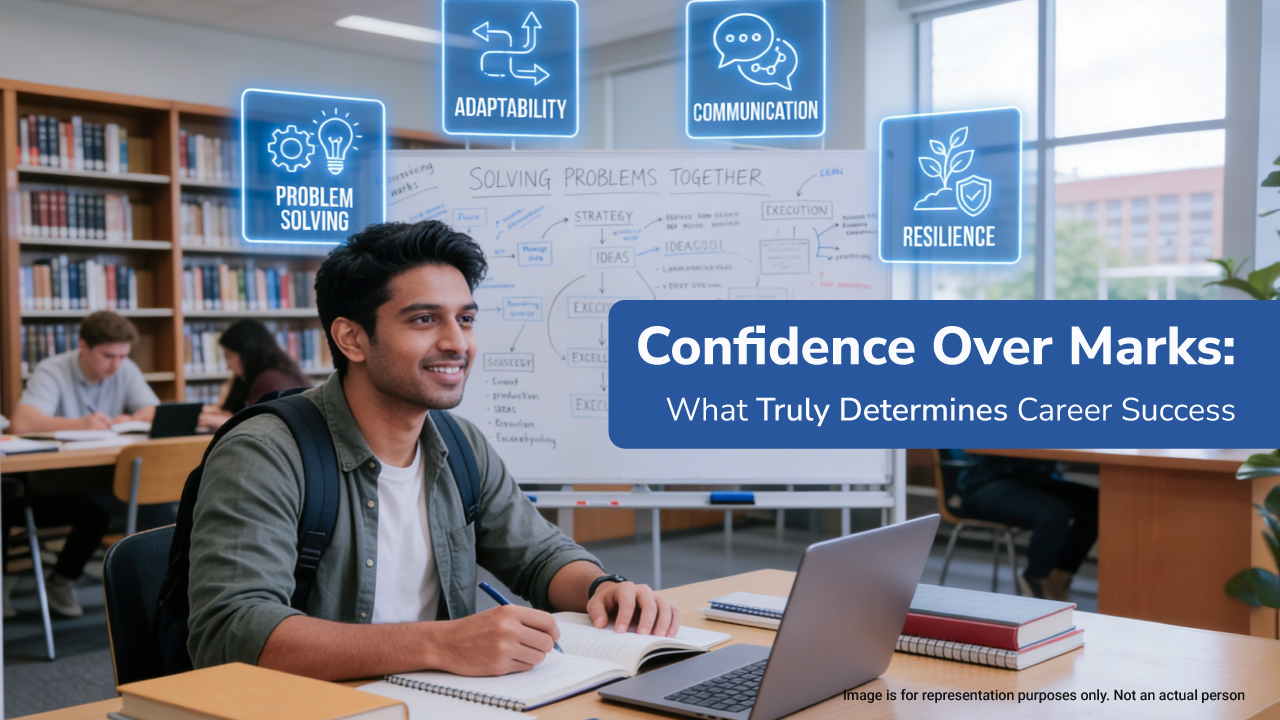
Career success is shaped by a combination of factors that go far beyond academic performance.
-
Problem-solving ability: The capacity to break down complex challenges and find workable solutions
-
Adaptability: The willingness to learn, unlearn, and evolve with changing environments.
-
Communication: The ability to express ideas clearly and work effectively with others.
-
Resilience: The strength to handle setbacks and keep moving forward.
-
Initiative: The drive to act, create, and take responsibility.
These are the qualities that sustain long-term growth. They are built over time, through experience, not exams.
Marks may reflect past performance. Confidence reflects future potential.
Redefining Success for the Next Generation
The definition of success is changing. It is no longer about being the top scorer in a classroom. It is about being prepared for the complexities of the real world.
Students who focus only on marks may find themselves unprepared for situations that require independent thinking. Those who focus on building skills, experiences, and confidence are better equipped to navigate uncertainty.
This does not mean marks are irrelevant. It means they are not enough.
The real advantage lies in developing the ability to learn continuously, apply knowledge effectively, and grow through challenges.
<h2>How TheBridge Builds Confidence Beyond Marks</h2>
TheBridge is designed precisely to bridge the gap between academic and real-world skills. They do this by focusing on building confidence through experience rather than conventional learning approaches.
Students engage in project-based learning, where answers are not known in advance. Students develop critical thinking, decision-making, and ownership skills. This turns learning from receptive to generative.
Mentoring is an important part of this process. Armed with advice from industry professionals, students learn to apply their skills in the real world. It provides clarity, focus, and motivation.
At the same time, TheBridge emphasizes essential human skills such as communication, collaboration, and adaptability. These are developed alongside technical capabilities, creating a balanced and future-ready skill set.
The goal is not just to help students perform well in exams, but to prepare them to perform well in life.
Because in the end, marks may open the first door. But confidence determines how far one can go beyond it.