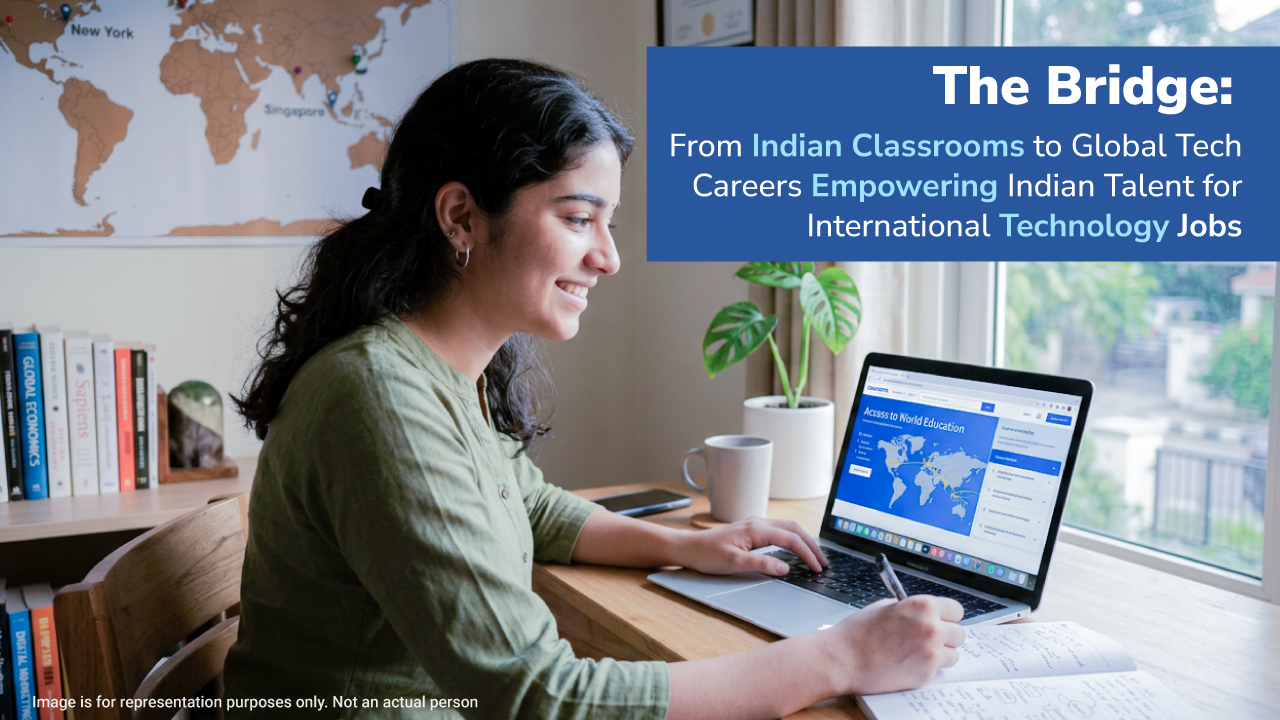
Riya was sitting at the end of her college computer lab, looking at lines of code she was supposed to memorize for an exam the following morning. She knew how to pass tests. She had good grades. But daily, a silent terror accompanied her: Would this experience help her secure a real job? Like the millions of students in India, Riya was a well-educated, ambitious, and hardworking young woman, but she did not know how to move from the classroom to the career ladder.
Why Indian Graduates Need Practical Tech Skills for Global Technology Careers
Indian education has long emphasized theory. While textbooks explain concepts and exams test memory, today’s employers in global technology seek practical skills, problem-solving ability, teamwork, and adaptability. This disconnect between theoretical learning and real-world tech jobs often leaves students like Riya unprepared for the job market.
In her final year, Riya attended a career guidance session, and a mentor asked her a simple question: to demonstrate what she could create rather than what she knew. The change in that question. It opened her eyes to the fact that learning did not end with lectures but began the moment knowledge was applied.
This is the plight of most Indian students today. Technology is changing at a rate far faster than syllabi can keep up with. The new reality is cloud computing, data analytics, AI tools, and global collaboration platforms. However, even after graduating from college, many graduates lack experience working on real-world projects, collaborating in international teams, or understanding workplace expectations beyond grades.
Students seek employment but aspire to meaningful careers. They desire to be confident in the interview room, competent in their jobs, and competitive in the global market. The thing they usually lack is systematic training that bridges the gap between learning and practice.
Project-Based Learning: Essential for Job-Ready Skills & Global Employability of Indian Tech Graduates
In Riya's case, project-based learning was the avenue for such an association. She started solving open-ended problems rather than working on textbook problems with predetermined answers. She worked with colleagues, made mistakes, received feedback, and learned to think and work like a professional. Gradually, the feeling of fear gave way to clarity.
This process of passive learning, followed by active practice, will prepare students to become professionals. This is project-based learning! Students learn to communicate their ideas more effectively, manage their time, and adapt to change by working on real problems. They cease to view technology as a subject and begin to see it as an instrument for generating solutions. Confidence is not based on marksheets, but experience. The result is demonstrable, competency-based learning.
The other major transformation occurs when the students are exposed to international standards. Knowledge of the way global teams operate, of the way documentation is composed, of understanding the way deadlines are observed, and the way in which ethics are considered, is in itself a preparation of the student to work anywhere in the world. For Indian talent, this exposure is essential. The opportunity was always there; what was lacking was entry, guidance, and true competence-based programs.
Mentorship is a potent aspect in this change. Learners develop a perspective-guided approach when professionals with expertise in education and industry provide guidance. They learn which skills are critical, how to create a portfolio, and how to make prudent career decisions, rather than simply following trends.
When Riya graduated, she was no longer a degree holder. She had completed and presented work on practical technical projects and knew how her skills would be relevant to global technical roles; in other words, she was competent. Interviews were not extended interviews but conversations. She had bridged the gap between classroom preparation and career preparedness.
How TheBridge Program Prepares Indian Students for International Technology Jobs
TheBridge program bridges the gap between international education and employment for Indian students seeking careers in technology. Rather than replacing traditional classrooms, TheBridge enhances them by delivering real-world relevance and industry-aligned skills. Through project-based learning, mentorship from tech professionals, and exposure to global standards, TheBridge helps Indian learners build job-ready skills for international technology careers.
TheBridge focuses not only on certificates but also on building confidence, competence, and clarity for technical careers. The program equips learners with professional skills, teamwork abilities, and global perspectives. For Indian talent aspiring to succeed in the international technology market, TheBridge is the essential step from potential to purpose, thereby transforming classroom education into rewarding, future-ready technology careers.