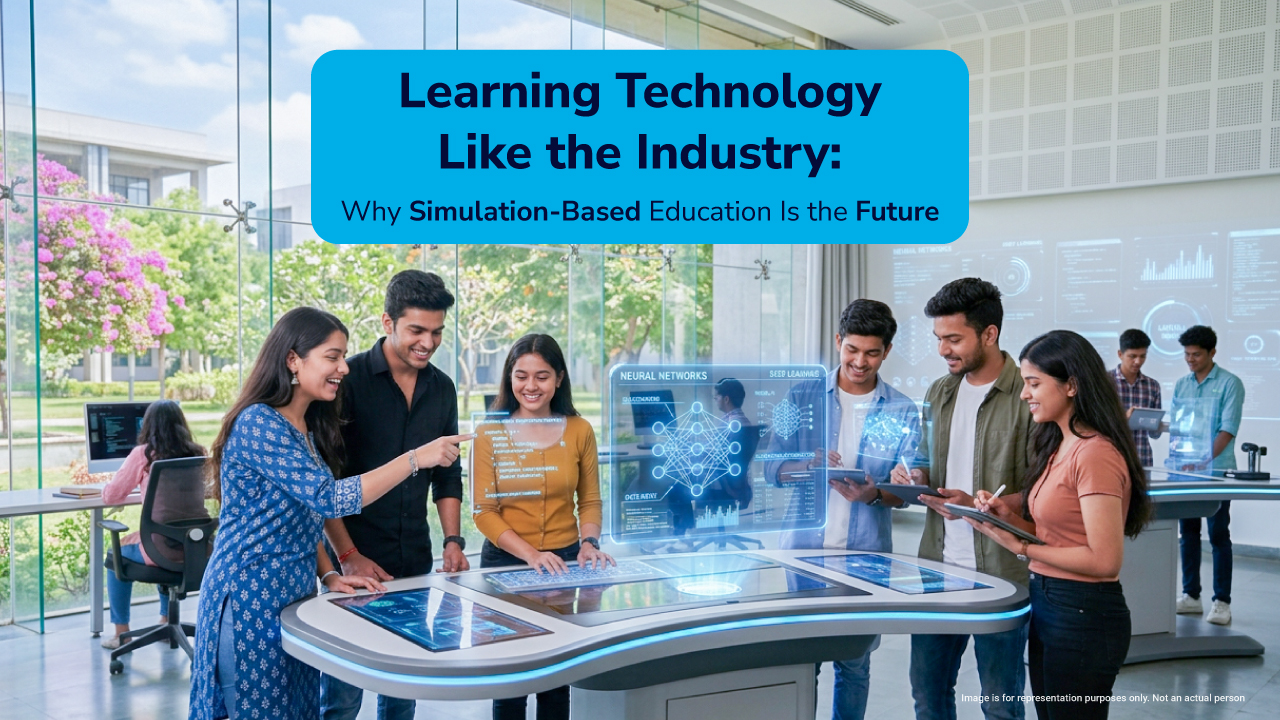
Nowadays, in most classrooms, students are seated at laptops, learning to write computer programs and algorithms and to perform tasks meant to test their knowledge of technical aspects. The format is well known: theories are taught through lectures, syntax is trained through exercises, and the level of knowledge is assessed through examinations. This method has been used to develop the teaching of technology over the decades.
Despite these efforts, recent studies show that 85% of engineers are not employable, highlighting a significant gap between academic training and industry requirements. However, when students leave school and begin working in their first professional position in technology, many discover a shocking truth. The workplace is not similar to the classroom.
Technology firms do not operate on isolated assignments or individual coding tasks. On the contrary, they operate in groups, within timeframes, through decision-making, and continuously. Engineers hardly operate in isolation from clearly defined issues. They collaboratively construct products, explore the unknown, act on user feedback, and adapt solutions as the real world changes.
Such a disparity between academic and industry practice is now one of the most significant dilemmas in technology education.
A student can learn to write code in various programming languages, but will still not be able to work in a team for professional development. They can be familiar with algorithms, but have no idea how software is actually developed, tested, implemented, and enhanced in a real-world business setting.
Why Simulation-Based Learning Matters
This is why simulation-based teaching is proving to be an influential model in the future of technology learning.
Education through simulation shifts the focus from just knowing concepts to actually experiencing how technology works. Students are not restricted to theoretical tasks; instead, they are exposed to settings that reflect the work processes, teamwork practices, and problem-solving activities in contemporary tech companies.
Learning in these environments is like the rhythm of the industry. Students can be divided into small teams to create a digital product. Some design the user experience, those who build backend systems, and those who handle data pipelines or test systems. The project is developed in phases similar to an actual technology product.
The problem is defined, the solution is designed, prototypes are created, the system's functionality is tested, and the system is refined based on feedback. Deadlines create momentum. Technical difficulties suddenly arise, forcing you to think outside the box. Communication is made as significant as coding.
In the process, students would start to learn that one of the things that are normally hard to learn in traditional learning settings is the development of technology, which is not about writing code. It is concerning the construction of systems in partnership.
Industry Tools & Workflows in Education
The other element of simulation-based learning is exposure to the instruments and processes used in industry. Professional-level technology teams are based on systematic, efficient, quality-driven development.
Those are version control, collaborative code review, agile development cycles, continuous integration systems (which test and automatically deploy), and so on. Students who undergo these workflows at this age come to understand the professional settings they will ultimately join.
They are not exposed to these processes during their first employment, as they already know how collaborative development operates.
Building Skills for Ambiguous, Real-World Problems
The skill of solving ambiguous problems is also acquired through simulation-based learning. In the conventional academic environment, questions tend to have definite answers. Students are aware of what is expected and how success can be measured.
In practice, however, in a technology setting, issues are hardly defined so explicitly.
Some improvement may be required in a product, but it is not apparent what that improvement is. Under certain conditions, a system may fail, and it may be necessary to conduct an investigation and experiments. There are features that users may request, and that may introduce new technical constraints.
These complexities are revealed to students in simulation environments. They learn to derive incomplete information, experiment with solutions, and refine them over time. Such experiences instill confidence, strength, and flexibility- attributes that are fundamental to technology professionals.
Fostering Interdisciplinary Thinking
Another advantage of simulation-based education is that it promotes interdisciplinary thinking. Technology products in the modern world are seldom independent. They are software engineering, data science, user experience design, cybersecurity, and business strategy.
Students who are exposed to simulated product environments begin to recognize the interactions among these disciplines. A technical choice can affect user experience. Architecture can affect performance. Security requirements can influence the development of systems.
This more comprehensive view will help learners transcend limited technical knowledge and develop a better sense of how technology generates value in the real world.
Reimagining the Purpose of Learning
Simulation-based learning, perhaps the most important of all the above, changes the purpose of learning itself. Rather than seeing learning as a process that prepares them for the future, students come to see it as an active process in the present.
They are not merely learning about the functioning of technology; they are practicing how to construct it.
The ability to adapt and learn from real experience is becoming increasingly significant as the technological landscape evolves with artificial intelligence, cloud computing, and data-driven systems. Simulations offer a risk-free yet realistic environment in which students can learn and experiment, make mistakes, and eventually become better at what they will be doing as professionals.
This model is a major change in the design of technology education.
Instead of the current tendency to rely on lectures and theoretical instruction, the future of learning will increasingly shift toward experience, collaboration, and practical problem-solving. It is not only that students will graduate with technical knowledge, but also with the confidence that they have developed technologies in settings as close to industry as possible.
How TheBridge Implements Simulation-Based Learning
TheBridge uses this philosophy to develop learning experiences that replicate the dynamics of real technology ecosystems. Project-based learning involves having students collaborate to address significant problems. It exposes them to the workflows and problem-solving strategies used by contemporary technology organizations.
Learners are not taught technology in isolation, but in real-life situations that showcase innovation. This assists them in gaining technical competence and a teamwork attitude that will see them excel in the world of technology.
By connecting the classroom with industry, TheBridge not only equips students with the knowledge to interpret technology but also helps them create and build it in the real world outside the classroom.